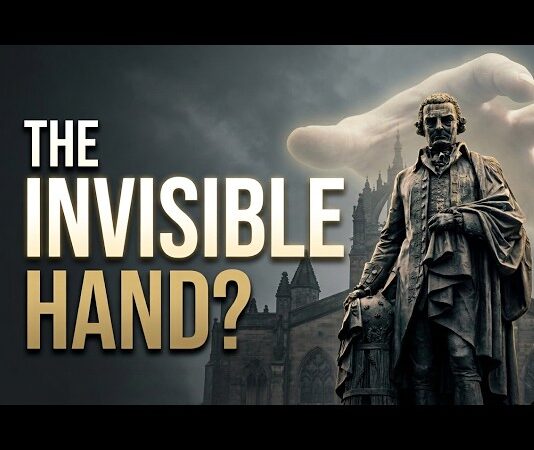
Often misquoted as a simple advocate for pure self-interest, Adam Smith actually viewed the division of labor as potentially eroding the intelligence and character of workers. He famously warned that the interests of large capitalists and merchants frequently conflict with the public good, as they seek monopolistic profits that corrupt society.
Smith’s “invisible hand” was not a guarantee that self-interest always benefits society, but a specific mechanism where the rich distribute the produce of their improvements to the poor simply by consuming little more than necessary. He argued that a nation’s true wealth lies in agriculture and domestic industry to supply food and needs, rather than in trade luxuries or accumulated gold.
Furthermore, Smith was a fierce critic of mercantilism and government-granted monopolies, such as the East India Company, which he saw as sources of waste and corruption. He believed that civil government was often instituted to defend the rich against the poor, and he supported progressive taxation where the wealthy contribute more than proportionally to public expenses.
What Does The KJV Bible Say?
The financial genius of Adam Smith lies in his discovery of “emergent order”—the way competition channels individual self-interest to benefit society—yet modern textbooks frequently misquote him as a prophet of unchecked laissez-faire. While popular culture frames his “invisible hand” as an omnipotent force justifying boundless greed, Smith actually used the phrase only once in The Wealth of Nations to address a highly specific risk-reduction behavior: a merchant preferring domestic trade over foreign trade for personal security. Smith explicitly warned that without robust moral constraints, active competition, and legal structures to prevent monopolies, unbridled self-interest degrades into predatory exploitation.
The KJV Biblical Context on Wealth & Self-Regulation
Scripture provides a parallel framework for assessing the tension between individual labor and societal stewardship. While Adam Smith examined how the marketplace balances human self-interest, the King James Version (KJV) addresses the root of the heart, warning that wealth without moral governance leads to spiritual ruin.
| Concept | Adam Smith’s Economic View | KJV Biblical Verse | Theological Takeaway |
|---|---|---|---|
| Self-Interest vs. Greed | Human desire for self-improvement drives industry but requires a moral framework. | Luke 12:15 – “And he said unto them, Take heed, and beware of covetousness: for a man’s life consisteth not in the abundance of the things which he possesseth.” | True value cannot be measured by a nation’s material output or individual hoarding. |
| The Invisible Hand / Emergent Order | Spontaneous market coordination channels human choices into collective stability. | Proverbs 16:9 – “A man’s heart deviseth his way: but the Lord directeth his steps.” | Human agents act with localized intentions, but a higher sovereign order governs the final outcome. |
| The Danger of Monopolies | Collusion among merchants distorts markets and cheats the public. | Proverbs 11:26 – “He that withholdeth corn, the people shall curse him: but blessing shall be upon the head of him that selleth it.” | Manipulating supply and bottlenecking the market for private extraction is strictly condemned. |
| The Purpose of Labor | Specialization and diligent labor build the tangible wealth of a nation. | Proverbs 13:11 – “Wealth gotten by vanity shall be diminished: but he that gathereth by labour shall increase.” | Generative production builds stable wealth, whereas financial speculation or exploitation decays. |
10 Examples of the “Real” Adam Smith vs. The Misquotes
- The Core “Invisible Hand” Misquote: Textbooks claim Smith said “The free market is always guided by an invisible hand to optimize the economy.”
- The Reality: Smith never wrote “of the market.” The phrase appears once in The Wealth of Nations specifically describing why investors keep capital close to home to minimize personal risk.
- The “Greed is Good” Fallacy: Modern corporate champions state that Smith believed pure, unchecked greed inherently solves poverty.
- The Reality: In his foundational work, The Theory of Moral Sentiments, Smith argued that human behavior is fundamentally driven by sympathy and mutual recognition, not merciless egoism.
- The Butcher, Brewer, and Baker: Commentators misquote his line on self-interest to imply that business owners owe nothing to community morals.
- The Reality: Smith noted that while we appeal to their self-love rather than benevolence for our dinner, those businesses only survive if a framework of justice prevents them from poisoning or defrauding the consumer.
- The Laissez-Faire Maxim: Hardline libertarians frequently use Smith’s name alongside the absolute command of “Laissez-faire, laissez-passer!”
- The Reality: Smith never used the term laissez-faire in his published works; the phrase originated from French physiocrats.
- The Role of Government: Modern deregulation advocates argue that Smith wanted zero state intervention in banking and commerce.
- The Reality: Smith aggressively defended state-funded public education, infrastructure (roads and bridges), and strict regulations on banking sectors to prevent speculative systemic collapse.
- Corporate Monopolies: Pro-monopoly entities cite free trade to protect massive corporate mergers.
- The Reality: Smith hated corporate cartels, famously writing that “people of the same trade seldom meet together… but the conversation ends in a conspiracy against the public.”
- The Nature of Wealth: Mercantilists of his era (and tariff-heavy nationalists today) argued that national wealth equals gold reserves and trade surpluses.
- The Reality: Smith proved that real wealth is the productivity, skills, and total output of a nation’s labor force.
- The Blindness of “Trickle Down”: Analysts argue Smith invented trickle-down economics by stating the rich automatically distribute wealth fairly.
- The Reality: When Smith mentioned the invisible hand in The Theory of Moral Sentiments, he was satirically describing a gluttonous landlord who can physically consume only a fraction of his harvest and is forced to hand over the rest to his servants.
- The Division of Labor Pitfall: Textbooks praise Smith’s pin factory example to support endless assembly-line efficiency.
- The Reality: Smith warned that making a worker repeat the same micro-task all day would render them “as stupid and ignorant as it is possible for a human creature to become,” mandating public education to offset this damage.
- The “Magical” Self-Correcting Market: Pop-economics states that markets instantly self-correct without human effort.
- The Reality: Smith explicitly showed that market efficiency relies entirely on vigorous competition. If buyers or sellers collude to eliminate options, the market mechanism breaks down.
Psychological & Analytical Expert Reports
1. The Myers-Briggs Type Indicator (MBTI) Analyst Report
- Subject Profile: INTJ / INTP (The Architect / Logician Variant)
- Core Mental Dynamic: Dominant Introverted Intuition (Ni) or Introverted Thinking (Ti), paired with highly structured Extraverted Thinking (Te).
- Analytical Breakdown: Smith’s true genius was system-building. He did not look at financial mechanics in isolation; he tracked macro-level trends and synthesized human psychology with systemic output. The misinterpretation of his work stems from an extraverted distortion: modern critics extract his structural, mechanics-oriented insights (Te) while discarding the deeply internal moral architecture (Fi/Ti) that served as his foundation. He viewed the economy as an evolving ecosystem rather than a rigid machine.
2. The John MacArthur Analyst Report
- Subject Profile: Theological Expositor / Biblical Sovereignty Lens
- Analytical Breakdown: From a biblical expository view, Adam Smith discovered a secular manifestation of common grace and providential order. What secularists call the “invisible hand” is simply the natural design of God’s creation, where even fallen, self-interested men are constrained to serve their neighbor in order to survive. However, the modern misinterpretation that divorces Smith from morality is an expression of human depravity. It attempts to justify sinful covetousness under the guise of an economic system. True national wealth cannot endure without righteousness.
3. The Paul Washer Analyst Report
- Subject Profile: Radical Reformation / Heart-Examining Lens
- Analytical Breakdown: Adam Smith understood something modern prosperity preachers and secular capitalists despise: the unmitigated deceitfulness of the human heart. Smith knew that if you give fallen humans unchecked economic power, they will build predatory monopolies to crush the poor. Modern financial systems quote Smith selectively because they want his economic liberty without his call for moral restraint. A society that celebrates absolute self-interest without a deep fear of God is not experiencing liberty; it is rushing headlong into spiritual and systemic judgment.
4. The Greg Schad Analyst Report
- Subject Profile: Risk Management & Data Integrity Perspective
- Analytical Breakdown: Looking at the data, the popular interpretation of Smith represents a massive breakdown in documentation integrity and audit control. Smith’s single use of the phrase in The Wealth of Nations serves as a risk-reduction metaphor for domestic capital retention. It was introduced into modern textbooks as an unconstrained macroeconomic maxim by Paul Samuelson in 1948. This demonstrates a classic data-drift anomaly: a localized risk mitigation parameter was misapplied as a universal optimization algorithm, introducing systemic moral hazard across global corporate structures.
5. The Jordan Peterson Analyst Report
- Subject Profile: Archetypal / Evolutionary Psychology Lens
- Analytical Breakdown: It is an absolute catastrophe of misrepresentation. Smith wasn’t writing a handbook for narcissistic sociopaths; he was mapping out the emergent archetypal structures of human cooperation. The marketplace is a complex, bottom-up game predicated on trust, competence, and iterative reciprocity. When you misquote Smith to mean “greed is a virtue,” you are trying to win a single turn of the game by cheating. But that breaks the game entirely. Smith’s true genius was realizing that the market is a proxy for the human conscience—a structure where you must provide genuine value to another human being to justify your own existence.
6. The Carl Jung Analyst Report
- Subject Profile: Analytical Psychology / Shadow Integration Lens
- Analytical Breakdown: The modern obsession with the “invisible hand” is a psychological projection of the collective unconscious. Society has projected the archetype of the Wise Old Man or a protective, omnipotent deity onto the marketplace itself, assuming this “hand” will clean up our moral messes. By treating the market as a magical entity that transforms private vices into public virtues, modern economics has repressed its own Shadow—the dark reality of exploitation and corporate greed. True individuation for an economic system requires accepting that the market possesses no soul of its own; its light and darkness are merely reflections of the collective human psyche.
Note: We do use YouTube Video’s under the “Fair Use” Act under the Copyright Law:
“Fair use is a doctrine in the United States copyright law codified in Section 107 of the Copyright Act of 1976.1 It provides for the legal, non-licensed citation or incorporation of copyrighted material in another author’s work without requiring permission from the rights holders, such as for commentary, criticism, news reporting, research, teaching or scholarship.01 The U.S. Copyright Office Fair Use Index should prove helpful in understanding what courts have to date considered to be fair or not fair but it is not a substitute for legal advice.2“
Check out our last minute travel deals: Travelanycountry.com

Save Up To 60% Off Hotels, Flights, Cruises, Rental Cars More…
Product Reviews Ebay.com, Walmart.com, Clickbank, Cabela’s And More…
Women Product Reviews
- Women’s Handbags And Purses At Your Local Walmart Or Online Near Me!
- Women’s Clothes At Your Local Walmart Or Online Near Me!
- Kate Spade New York Women’s Carlyle Medium Shoulder Handbag – Black
- Kate Spade Leila Medium Gingerbread Leather Triple Compartment Satchel Handbag Product Review From Walmart
- MKF Collection Gabriella Handbag with Wallet by Mia K.
- MKF Collection Bonita Checkered Tote 2 Pcs Women’s Large Handbag with Wallet and Decorative M keychain by Mia k.
- Michael Kors 35H1T2Jt1C Jodie Small Logo Jacquard Tote Bag In Atom Green
- Michael Kors Gilly Drawstring Large Top Zip Tote Ballet Pink Mk Signature
- Michael Kors 35F1GTVT3B Jet Set Travel Large Chain Shoulder Tote Bag MK Signature Brown
Product Reviews – Apples Phones, TV, Ipads, Laptops, Watches
- Apple AirTag 4 Pack
- Apple AirPods Pro (2nd Generation) Wireless Earbuds, Up to 2X More Active Noise Cancelling, Adaptive Transparency, Personalized Spatial Audio, MagSafe Charging Case, Bluetooth Headphones for iPhone
- Apple Watch Series 3 GPS Silver – 42mm – White Sport Band
Product Reviews – Camera’s, Gimbal’s, Video Equipment.
Canon EOS M50 Mark II + EF-M 15-45mm is STM Kit Black Product Review
Other Product Reviews – Lawncare, Tools, Fishing Gear.
Troy-Bilt Pony 42″ Riding Lawn Mower Tractor with 42-Inch Deck and 439cc 17HP Troy-Bilt Engine
Costway 6.3 Quart Tilt-Head Food Stand Mixer 6 Speed 660W w/Dough Hook, Whisk Black
I COMPARE 4 RVs: Campervan, Class C, 5th Wheel & Truck Camper. 20 Factors to Consider
Offshore Angler Tightline II Spinning Reel
Lodge Tall Boy Camp Dutch Oven Tripod
Bear Archery Species EV RTH Compound Bow Package
Minn Kota Terrova Bow Mount Freshwater Trolling Motor with i-Pilot GPS Trolling System
Cabela’s Treadfast GORE-TEX Insulated Hunting Boots for Men
Classic Accessories Over Drive RV Sway Bar Hitch Tote, Black
Hughes Autoformers Power Watchdog Portable RV Bluetooth Surge Protector, 30 Amp
Black Max 21-inch 3-in-1 Self-Propelled Gas Mower with Perfect Pace Technology
Best Choice Products 6V Portable Sewing Machine, 42-Piece Beginners Kit w/ 12 Stitch Patterns – Teal
Please visit our Sponsors: