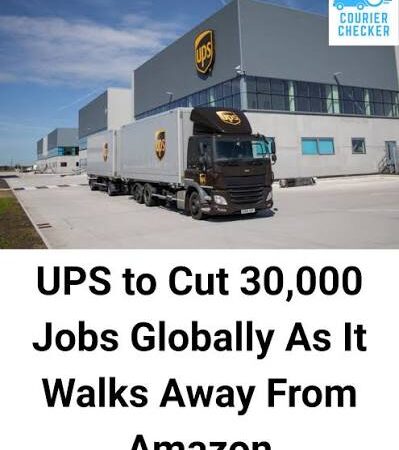
UPS is strategically reducing its dependence on Amazon because the e-commerce giant’s shipping volume, while large, was unprofitable and dilutive to UPS’s domestic margins. Although Amazon accounted for roughly 11.8% of UPS’s 2024 revenue and was its largest customer, CEO Carol Tomé stated that Amazon was not the company’s most profitable partner, with outbound last-mile deliveries often priced below UPS’s fully loaded cost to serve.
By mid-2026, UPS phased out its standard last-mile delivery services for Amazon, cutting 2 million packages per day and shedding approximately $5 billion in revenue. This “glide down” allows UPS to reallocate network capacity toward higher-margin business, including healthcare logistics, small- and medium-sized businesses (SMBs), and business-to-business (B2B) freight, which generate better revenue per piece.
To support this pivot, UPS has executed the largest network reconfiguration in its history, including closing over 70 facilities and cutting tens of thousands of jobs to align its cost structure with lower parcel volumes. The company continues to handle Amazon returns and marketplace logistics, which remain profitable, while Amazon has increasingly insourced its own short-distance deliveries as it built out its own supply chain infrastructure.
UPS intentionally cut over 50% of its Amazon shipping volume through mid-2026 to stop subsidizing a low-margin competitor and refocus on higher-profit sectors like healthcare and small businesses. Under CEO Carol Tomé’s “Better, Not Bigger” strategy, the carrier eliminated roughly 2 million daily Amazon packages and $4.5 billion in associated operating expenses to protect its long-term margins.
Strategic Comparison: The Amazon “Glide Down”
| Metric / Operational Area | Before Restructuring (2024) | Post-Restructuring (Late 2026) | Strategic Impact |
|---|---|---|---|
| Amazon Share of UPS Volume | ~20% to 25% of U.S. network volume | Reduced by >50% (~2 million fewer pieces/day) | Eliminates network congestion during peak sorting hours. |
| Amazon Share of UPS Revenue | 11.8% of total revenue | ~5% to 6% (focused mainly on UPS Store returns) | Sacrifices ~$5 billion in low-margin revenue for higher unit economics. |
| Physical Network Footprint | Legacy manual & semi-automated hubs | Closed ~150 sort facilities; 68.5% volume automated | Cuts fixed overhead and lowers cost per piece by 28% in automated hubs. |
| Workforce & Labor Hours | Expanded post-pandemic headcount | Eliminated ~78,000 positions (2025–2026) & 50M labor hours | Aligns unionized labor costs with profitable, non-dilutive parcel demand. |
| Primary Growth Targets | Broad residential e-commerce | Healthcare logistics, B2B, data center gear, and SMBs | Drives U.S. domestic operating margin expansion (+100 to +400 bps). |
10 Concrete Examples of Why UPS Walked Away
- Severe Margin Dilution. Amazon packages accounted for up to a quarter of UPS’s U.S. parcel volume in 2024 but generated only 11.8% of total revenue, dragging down overall company profitability.
- Last-Mile Cherry-Picking. Because Amazon spent over $100 billion building its own in-house logistics network, it kept dense, profitable urban routes for its own vans and handed off expensive, rural, or bulky last-mile deliveries to UPS.
- Facility Bottlenecks. Millions of low-margin Amazon parcels clogged UPS sorting hubs, delaying higher-paying commercial and business-to-business shipments.
- Funding a Direct Rival. Amazon began selling its own third-party logistics services (Amazon Shipping) to outside merchants, meaning UPS was effectively helping a direct competitor scale its infrastructure.
- High Union Labor Costs. Following its 2023 Teamsters contract, UPS faced rising driver and warehouse wages that made hauling deeply discounted e-commerce boxes financially unsustainable.
- Healthcare Logistics Expansion. UPS freed up air and ground capacity to capture cold-chain pharmaceutical and medical device deliveries, which command significantly higher revenue per piece.
- Small and Medium Business (SMB) Focus. SMB shippers lack Amazon’s massive volume leverage, paying much closer to retail rates and generating healthier margins for UPS.
- Data Center & B2B Supply Chains. UPS redirected operational focus toward specialized, high-value commercial freight, such as computer hardware for AI data centers.
- Network Automation Efficiency. Shedding 2 million daily packages allowed UPS to close 150 older buildings and route 68.5% of its remaining U.S. volume through modern, automated hubs.
- Retaining High-Margin Returns. Rather than doing a messy total exit like FedEx did years earlier, UPS kept the lucrative portion of the partnership—processing Amazon returns across its 5,200 UPS Store locations.
Multi-Perspective Analyst Reports
1. Myers-Briggs (MBTI) Analyst Report: ISTJ (The Logistician) vs. ENTJ (The Commander)
- The Shift: Historically, UPS operated like a classic ISTJ—dutiful, tradition-bound, and obsessed with executing reliable, high-volume routines regardless of external shifts. Under Carol Tomé, UPS pivoted to an ENTJ mindset: strategic, unsentimental, and ruthlessly focused on systemic efficiency and long-term capital allocation.
- Diagnosis: An ENTJ leader refuses to let sunk-cost nostalgia dictate corporate survival. By severing an unhealthy dependency on Amazon (an aggressive ENTJ rival), UPS stopped playing a losing volume game and reasserted executive control over its own operational architecture.
2. John MacArthur Analyst Report: Stewardship, Pride, and the Peril of Unequal Yokes
- The Shift: Viewed through the lens of expository biblical stewardship, a company is entrusted with resources, capital, and laborers that must be managed with discernment rather than blind greed for market share.
- Diagnosis: UPS fell into the trap of coveting sheer size (“bigger”) over faithfulness and soundness (“better”). By yoking itself to a dominant tech titan that dictated terms and eroded the carrier’s foundation, UPS compromised its core integrity. Walking away represents a sobering, painful repentance from corporate vanity—pruning dead branches and enduring the humiliation of layoffs so the enterprise might survive.
3. Paul Washer Analyst Report: Radical Examination and the Cost of Compromise
- The Shift: Applying a radical, uncompromising call to self-examination, corporate metrics often mask deep structural decay. Wall Street applauds “top-line revenue growth” while ignoring the rot occurring beneath the surface.
- Diagnosis: You cannot claim to be a healthy logistics company while allowing a single master to hollow out your margins and enslave your workforce to unprofitable labor. UPS’s decision to cut half its Amazon volume is a rare, radical act of corporate self-denial—choosing the narrow, difficult road of operational discipline over the broad, deceptive road of empty package counts.
4. Jordan Peterson Analyst Report: Dominance Hierarchies, Parasitism, and Voluntary Sacrifice
- The Shift: In any complex economic dominance hierarchy, symbiotic relationships can quietly mutate into parasitic ones when one party grows large enough to dictate all rules of engagement.
- Diagnosis: UPS was confronting a classic dragon: if it failed to voluntarily sacrifice 2 million packages today, Amazon would eventually consume its entire margin structure tomorrow. True competence requires the courage to say “no” to short-term comfort, bear the immediate pain of shrinking (closing 150 facilities and cutting jobs), and rebuild order out of chaos so the institution remains sovereign.
5. Carl Jung Analyst Report: Individuation and Confronting the Corporate Shadow
- The Shift: Jungian individuation requires an entity to separate its true self from the collective persona and confront its repressed “Shadow”—the hidden weaknesses it refuses to acknowledge.
- Diagnosis: For a decade, UPS’s Persona was “the indispensable backbone of global e-commerce,” while its Shadow was a growing terror of irrelevance without Amazon’s volume. By clinging to Amazon, UPS remained trapped in psychological co-dependency. Walking away marks UPS’s painful individuation: integrating its Shadow, accepting the death of its old identity, and emerging as a differentiated, self-directed enterprise.
Bibliography & Sources
- CNBC. (2025, January 30). UPS shares tank after weak guidance, plan to slash Amazon deliveries by more than half.
- Distribution Strategy Group. (2026, September 18). UPS Reshapes Global Operations After Cutting Amazon Volume.
- FreightWaves. (2026, July 28). UPS shift away from Amazon shows bigger payoff.
- Inc. (2025, February 8). 7 Words Explain Why UPS Is Cutting Amazon Loose.
- Marketplace. (2026, July 28). Why UPS is winding down Amazon deliveries.
- Supply Chain Digital. (2025, February 3). Why UPS is Slashing Amazon Shipping Volumes by 50%.
- WABE. (2026, July 28). UPS completes Amazon volume cut and turns its attention to AI and healthcare.
- Yahoo Finance. (2026, August 20). UPS Is Walking Away From Amazon. Is That a Smart Move?.
Note: We do use YouTube Video’s under the “Fair Use” Act under the Copyright Law:
“Fair use is a doctrine in the United States copyright law codified in Section 107 of the Copyright Act of 1976.1 It provides for the legal, non-licensed citation or incorporation of copyrighted material in another author’s work without requiring permission from the rights holders, such as for commentary, criticism, news reporting, research, teaching or scholarship.01 The U.S. Copyright Office Fair Use Index should prove helpful in understanding what courts have to date considered to be fair or not fair but it is not a substitute for legal advice.2“
Check out our last minute travel deals: Travelanycountry.com

Save Up To 60% Off Hotels, Flights, Cruises, Rental Cars More…
Product Reviews Ebay.com, Walmart.com, Clickbank, Cabela’s And More…
Women Product Reviews
- Women’s Handbags And Purses At Your Local Walmart Or Online Near Me!
- Women’s Clothes At Your Local Walmart Or Online Near Me!
- Kate Spade New York Women’s Carlyle Medium Shoulder Handbag – Black
- Kate Spade Leila Medium Gingerbread Leather Triple Compartment Satchel Handbag Product Review From Walmart
- MKF Collection Gabriella Handbag with Wallet by Mia K.
- MKF Collection Bonita Checkered Tote 2 Pcs Women’s Large Handbag with Wallet and Decorative M keychain by Mia k.
- Michael Kors 35H1T2Jt1C Jodie Small Logo Jacquard Tote Bag In Atom Green
- Michael Kors Gilly Drawstring Large Top Zip Tote Ballet Pink Mk Signature
- Michael Kors 35F1GTVT3B Jet Set Travel Large Chain Shoulder Tote Bag MK Signature Brown
Product Reviews – Apples Phones, TV, Ipads, Laptops, Watches
- Apple AirTag 4 Pack
- Apple AirPods Pro (2nd Generation) Wireless Earbuds, Up to 2X More Active Noise Cancelling, Adaptive Transparency, Personalized Spatial Audio, MagSafe Charging Case, Bluetooth Headphones for iPhone
- Apple Watch Series 3 GPS Silver – 42mm – White Sport Band
Product Reviews – Camera’s, Gimbal’s, Video Equipment.
Canon EOS M50 Mark II + EF-M 15-45mm is STM Kit Black Product Review
Other Product Reviews – Lawncare, Tools, Fishing Gear.
Troy-Bilt Pony 42″ Riding Lawn Mower Tractor with 42-Inch Deck and 439cc 17HP Troy-Bilt Engine
Costway 6.3 Quart Tilt-Head Food Stand Mixer 6 Speed 660W w/Dough Hook, Whisk Black
I COMPARE 4 RVs: Campervan, Class C, 5th Wheel & Truck Camper. 20 Factors to Consider
Offshore Angler Tightline II Spinning Reel
Lodge Tall Boy Camp Dutch Oven Tripod
Bear Archery Species EV RTH Compound Bow Package
Minn Kota Terrova Bow Mount Freshwater Trolling Motor with i-Pilot GPS Trolling System
Cabela’s Treadfast GORE-TEX Insulated Hunting Boots for Men
Classic Accessories Over Drive RV Sway Bar Hitch Tote, Black
Hughes Autoformers Power Watchdog Portable RV Bluetooth Surge Protector, 30 Amp
Black Max 21-inch 3-in-1 Self-Propelled Gas Mower with Perfect Pace Technology
Best Choice Products 6V Portable Sewing Machine, 42-Piece Beginners Kit w/ 12 Stitch Patterns – Teal
Please visit our Sponsors: