
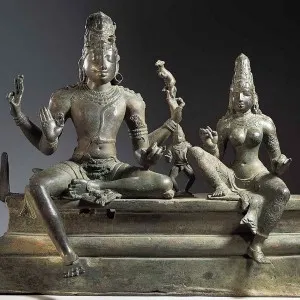
Brass statues have been crafted for over 2,000 years, with archaeological evidence dating their use back to the Indus Valley Civilization (c. 3300–1300 BCE).
- Ancient Origins: While the alloy itself may have been discovered as early as 5000 BCE, early Indian metalworkers produced finely crafted brass objects with sophisticated metallurgical knowledge long before modern manufacturing.
- Historical Peak: The tradition flourished significantly during the Chola Dynasty (9th to 13th centuries), where artisans perfected the lost-wax casting technique to create intricate deity statues.
- Global Usage: Beyond India, Ancient Egyptians used brass for statues and instruments, and the Roman Empire widely utilized it for decorative items and coins.
Why Do Buddhist Statues Heads Have Curly Hair
Why Do Greek And Roman Statues Always Have Curly Hair?
Revelation 1:14-15 (KJV) describes the glorified appearance of Jesus Christ as follows:
“His head and his hairs were white like wool, as white as snow; and his eyes were as a flame of fire; And his feet like unto fine brass, as if they burned in a furnace; and his voice as the sound of many waters.”
- White hair: Symbolizes majesty, purity, and eternity, drawing parallels to the “Ancient of Days” in Daniel.
- Flame of fire eyes: Represents omniscience and the ability to pierce through all things, seeing the secrets of all hearts.
- Fine brass feet: Denote the firmness of his appointments and the excellence of his proceedings, supported by strength.
- Sound of many waters: Indicates the power and majesty of his voice, likened to roaring ocean waves.
Why Do Black People Need To Believe Jesus Is Black?
The belief that Jesus was Black or the theological concept of the “Black Christ” stems from a desire for cultural identification, a rejection of colonialism, and a framework for liberation theology, rather than a strict historical consensus on his physical appearance.
Cultural Identification and Relatability — Many Black Christians argue that seeing a savior who shares their racial identity helps combat feelings of inferiority imposed by a society that has historically associated Whiteness with divinity and superiority. As noted by scholars and theologians, picturing Jesus as Black allows marginalized communities to see their own humanity reflected in their faith, countering the “whitewashed” images that were often used to justify slavery and colonial rule.
Liberation Theology and Solidarity — Prominent figures like James Cone, the father of Black theology, argue that Jesus’ “Blackness” is primarily a statement of solidarity with the oppressed. In this view, because Black people in America have historically suffered under white supremacy, Jesus identifies with them not necessarily through skin color, but through their shared experience of subjugation. This perspective frames Jesus as a liberator who stands against the systems of power that oppress Black lives.
Historical and Scriptural Arguments — Some advocates point to historical and biblical evidence to support the idea that Jesus was a man of color, likely with a darker complexion typical of the Middle East. They cite passages describing Jesus with hair “like wool” and feet “like burnished bronze,” and note that he fled to Egypt, where he would have needed to blend in with the local population. While the Bible does not explicitly state his skin color, these arguments are used to challenge the traditional European depiction of Jesus.
Criticism and Nuance — It is important to note that not all Black Christians believe Jesus was physically Black, and many theologians argue that his race is secondary to his message. Critics within and outside the community suggest that focusing on skin color can be divisive and that Jesus’ significance lies in his teachings and spiritual impact, which transcend racial boundaries. The concept of a “Black Jesus” is often more about social and political liberation than a literal historical claim.
Jesus is not BLACK! Philip Anthony Mitchell was RIGHT, and the BLACK HEBREW ISRAELITES are wrong!
The mainstream scholarly view: Jesus was a first-century Jewish man from the Levant (Nazareth/Bethlehem), with a Middle Eastern/Semitic complexion — generally described as olive to brown, not “black” in the modern African sense, and certainly not white. The Bible itself gives no physical description of him (Isaiah 53:2 says he had “no beauty or majesty to attract us”).
Philip Anthony Mitchell’s position: The 2819 Church pastor argued that depicting Jesus as black is a form of idolatry and that Jesus was a Middle Eastern Jew. He was confronted by Black Hebrew Israelite groups at his Access prayer events in Atlanta (June and October 2025).
The Black Hebrew Israelite position: Some groups within the movement teach that Jesus was black/African and that Black Americans are the true descendants of ancient Israel. These claims lack historical or anthropological support; the ADL and SPLC have designated some sects as hate groups due to antisemitism and Holocaust denial.
Where the debate gets complicated: Many Black Christians and scholars push back on Mitchell’s framing, arguing that the cultural depiction of a Black Jesus is a point of identification, not a literal claim about skin color — and that his “Christian before Black” rhetoric echoes white evangelical norms that marginalize Black identity in the church. A Rayshawn Substack piece (Oct 2026) argues his stance is “the radical contrarian call… against Black depictions of Jesus.”
So neither “Jesus was black” nor “Mitchell was simply right” is the full picture. The historical Jesus was a brown-skinned Middle Eastern Jew, and the dispute is really about theology, identity, and who gets to define that image.
What Did Jesus REALLY Look Like? Ethnicity, Hair, Skin, Eyes, Body Type.
Based on historical anthropology and forensic reconstruction, the historical Jesus was a first-century Judean Jew with olive-brown to tan skin, brown or black eyes, and short, dark, curly hair.
Ethnicity and Appearance — Research into ancient skeletal remains in the Southern Levant indicates that Judeans of this period were biologically closest to contemporary Iraqi Jews. Consequently, Jesus likely possessed typical Semitic features, including a prominent nose, high cheekbones, and a weathered complexion resulting from outdoor labor.
Physical Characteristics
- Height and Build: He was likely short by modern standards (approximately 5 feet 5 inches or 166 cm) with a lean, muscular, and sturdy physique, consistent with a manual laborer and traveler.
- Hair and Beard: Contrary to traditional Western art, he likely had short, dark, curly or frizzy hair and a short, cropped beard, adhering to first-century Jewish grooming customs.
- Clothing: He would have worn simple, modest garments such as a knee-length tunic, a belted waist, a woolen outer cloak with tassels, and leather sandals.
While biblical texts like Revelation describe a glorified, divine appearance (white hair, eyes of fire), these are symbolic. Historical evidence suggests he looked like an average Middle Eastern man of his time, lacking the long, light hair and fair skin depicted in later European iconography.
Note: We do use YouTube Video’s under the “Fair Use” Act under the Copyright Law:
“Fair use is a doctrine in the United States copyright law codified in Section 107 of the Copyright Act of 1976.1 It provides for the legal, non-licensed citation or incorporation of copyrighted material in another author’s work without requiring permission from the rights holders, such as for commentary, criticism, news reporting, research, teaching or scholarship.01 The U.S. Copyright Office Fair Use Index should prove helpful in understanding what courts have to date considered to be fair or not fair but it is not a substitute for legal advice.2“
Check out our last minute travel deals: Travelanycountry.com

Save Up To 60% Off Hotels, Flights, Cruises, Rental Cars More…
Product Reviews Ebay.com, Walmart.com, Clickbank, Cabela’s And More…
Women Product Reviews
- Women’s Handbags And Purses At Your Local Walmart Or Online Near Me!
- Women’s Clothes At Your Local Walmart Or Online Near Me!
- Kate Spade New York Women’s Carlyle Medium Shoulder Handbag – Black
- Kate Spade Leila Medium Gingerbread Leather Triple Compartment Satchel Handbag Product Review From Walmart
- MKF Collection Gabriella Handbag with Wallet by Mia K.
- MKF Collection Bonita Checkered Tote 2 Pcs Women’s Large Handbag with Wallet and Decorative M keychain by Mia k.
- Michael Kors 35H1T2Jt1C Jodie Small Logo Jacquard Tote Bag In Atom Green
- Michael Kors Gilly Drawstring Large Top Zip Tote Ballet Pink Mk Signature
- Michael Kors 35F1GTVT3B Jet Set Travel Large Chain Shoulder Tote Bag MK Signature Brown
Product Reviews – Apples Phones, TV, Ipads, Laptops, Watches
- Apple AirTag 4 Pack
- Apple AirPods Pro (2nd Generation) Wireless Earbuds, Up to 2X More Active Noise Cancelling, Adaptive Transparency, Personalized Spatial Audio, MagSafe Charging Case, Bluetooth Headphones for iPhone
- Apple Watch Series 3 GPS Silver – 42mm – White Sport Band
Product Reviews – Camera’s, Gimbal’s, Video Equipment.
Canon EOS M50 Mark II + EF-M 15-45mm is STM Kit Black Product Review
Other Product Reviews – Lawncare, Tools, Fishing Gear.
Troy-Bilt Pony 42″ Riding Lawn Mower Tractor with 42-Inch Deck and 439cc 17HP Troy-Bilt Engine
Costway 6.3 Quart Tilt-Head Food Stand Mixer 6 Speed 660W w/Dough Hook, Whisk Black
I COMPARE 4 RVs: Campervan, Class C, 5th Wheel & Truck Camper. 20 Factors to Consider
Offshore Angler Tightline II Spinning Reel
Lodge Tall Boy Camp Dutch Oven Tripod
Bear Archery Species EV RTH Compound Bow Package
Minn Kota Terrova Bow Mount Freshwater Trolling Motor with i-Pilot GPS Trolling System
Cabela’s Treadfast GORE-TEX Insulated Hunting Boots for Men
Classic Accessories Over Drive RV Sway Bar Hitch Tote, Black
Hughes Autoformers Power Watchdog Portable RV Bluetooth Surge Protector, 30 Amp
Black Max 21-inch 3-in-1 Self-Propelled Gas Mower with Perfect Pace Technology
Best Choice Products 6V Portable Sewing Machine, 42-Piece Beginners Kit w/ 12 Stitch Patterns – Teal
Please visit our Sponsors: