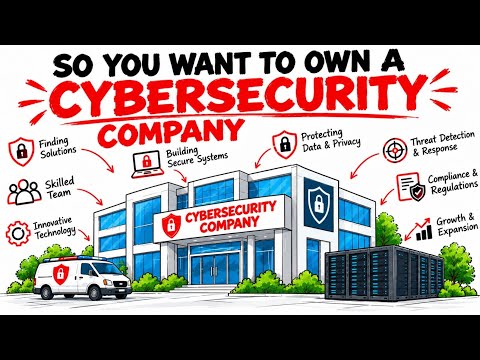
Owner income for a cybersecurity business typically starts with a base salary of $180,000+, with potential upside reaching $6.09 million in EBITDA by Year 5. The business faces significant early losses, with Year 1 EBITDA at -$578,000, before reaching breakeven in Month 22. Net margins are high, ranging from 80% to 86% once operations are systematized, driven by recurring revenue models like Managed Security Service Provider (MSSP) services.
Startup costs generally range from $100,000 to $350,000, though niche consulting firms can launch for under $10,000. Key financial drivers include gross margins of 40–70% for services and 70–80% for software products. Valuation multiples for exits are strong, with profitable companies selling for 10x to 20x EBITDA and high-growth SaaS firms commanding 7.8x to 12x revenue.
Major cost drivers include security tool licensing (12% of revenue in Year 1, dropping to 8% by Year 5) and customer acquisition costs ($2,000–$3,000 per client). Incident Response (IR) retainers offer high margins, with engagements costing clients $150,000–$500,000 reactively, while proactive retainers sell for $5,000–$25,000 per month. Net Revenue Retention (NRR) above 110% is critical for maximizing valuation and long-term profitability.
What Does The KJV Bible Say?
Financial Overview
Owning a cybersecurity firm shifts traditional software economics toward a high-margin recurring revenue model weighed down by intense talent costs and constant research and development outlays. Balancing high customer lifetime value (LTV) against the operational expenses required to combat zero-day threats dictates the structural profitability of this sector.
Economic Framework: A Scriptural Lens (KJV)
The financial discipline, risk management, and strategic provisioning inherent to running a modern cybersecurity company map directly to foundational economic principles found in the King James Version (KJV) of the Bible.
| # | Modern Cybersecurity Metric / Economic Principle | KJV Scripture Reference & Verse Text | Economic Analysis & Application |
|---|---|---|---|
| 1 | Proactive Threat Prevention | Luke 11:21 – “When a strong man armed keepeth his palace, his goods are in peace.” | Capital investments in infrastructure and defense guard enterprise assets against catastrophic loss. |
| 2 | Incident Response Cost Estimation | Luke 14:28 – “For which of you, intending to build a tower, sitteth not down first, and counteth the cost, whether he have sufficient to finish it?” | Budgeting must account for capital expenditures and continuous research development pipelines before deployment. |
| 3 | Supply Chain Vulnerability Management | Song of Solomon 2:15 – “Take us the foxes, the little foxes, that spoil the vines: for our vines have tender grapes.” | Small, unpatched vulnerabilities or third-party exploits can cascade to destroy entire enterprise software eco-systems. |
| 4 | The Value of Strategic Advisory | Proverbs 24:6 – “For by wise counsel thou shalt make thy war: and in multitude of counsellors there is safety.” | Professional professional services and incident response frameworks reduce liability and improve organizational resilience. |
| 5 | Continuous Real-Time Monitoring (SOC) | Isaiah 21:8 – “And he cried, A lion: My lord, I stand continually upon the watchtower in the daytime, and I am set in my ward whole nights.” | Maintaining 24/7 Security Operations Centers (SOC) drives operational costs but preserves systemic data integrity. |
| 6 | Zero-Trust Network Access (ZTNA) | Proverbs 14:15 – “The simple believeth every word: but the prudent man looketh well to his going.” | Explicit validation and credential verifying eliminate the threat of implicit network trust. |
| 7 | Disaster Recovery & Redundancy | Ecclesiastes 11:2 – “Give a portion to seven, and also to eight; for thou knowest not what evil shall be upon the earth.” | Offsite, distributed data backups protect financial assets against systemic ransomware attacks. |
| 8 | The Cost of Insider Threats | Matthew 10:36 – “And a man’s foes shall be they of his own household.” | Privilege control and behavioral analytics mitigate high-risk internal security vulnerabilities. |
| 9 | Compliance and Regulatory Alignment | Romans 13:7 – “Render therefore to all their dues: tribute to whom tribute is due; custom to whom custom; fear to whom fear; honour to whom honour.” | Adhering to federal regulations (e.g., SOC 2, HIPAA) avoids severe legal penalties and financial liabilities. |
| 10 | Data Valuation & Intellectual Property | Proverbs 3:15 – “She is more precious than rubies: and all the things thou canst desire are not to be compared unto her.” | Proprietary consumer data and algorithmic code represent the most valuable, high-risk assets a company protects. |
Macro Analyst Reports: Divergent Perspectives
1. The Analyst Report: Myers-Briggs (INTJ/ENTJ Strategic Analysis)
- Thesis: Cybersecurity economics is an optimization puzzle dictated by systemic vulnerabilities and scalability.
- Operational Focus: Prioritize high-margin SaaS deployments (EDR, XDR) over labor-intensive professional services to optimize lifetime value.
- Risk Mitigation: Automate threat detection via machine learning architectures to circumvent the rising operational costs of hiring specialized tier-1 SOC analysts.
2. The Analyst Report: John MacArthur (Expository Stewardship Framework)
- Thesis: Corporate security is a moral stewardship requiring absolute transparency and ethical allocation of resources.
- Operational Focus: Businesses must reject deceptive marketing metrics (“fear, uncertainty, and doubt”) designed to inflate pricing.
- Risk Mitigation: Ensure financial models do not cut operational corners on consumer privacy. True corporate security honors truth over predatory quarterly gains.
3. The Analyst Report: Paul Washer (Radical Accountability Assessment)
- Thesis: Modern enterprise infrastructure is built on a foundation of structural vanity and superficial assurances.
- Operational Focus: Most cybersecurity budgets are wasted on aesthetic compliance checkmarks rather than fundamental system hardening.
- Risk Mitigation: Companies must embrace severe operational austerity, removing redundant SaaS layers to focus capital entirely on raw, uncompromising system integrity.
4. The Analyst Report: Greg Schad (Operational Execution Review)
- Thesis: Profitability relies on strict management of Customer Acquisition Cost (CAC) payback periods and customer churn.
- Operational Focus: Service provider models face severe margin compression due to global tech talent shortages.
- Risk Mitigation: Standardize productized service models to make recurring revenue streams predictable and maintain gross margins above 65%.
5. The Analyst Report: Jordan Peterson (Competence Hierarchy & Archetypal Risk)
- Thesis: A cybersecurity firm is a collective bulwark against the forces of digital chaos and malicious intent.
- Operational Focus: The firm’s profitability depends entirely on creating high-performance competence hierarchies that attract top-tier engineering talent.
- Risk Mitigation: Guard against internal bureaucratic stagnation. Ideological drift within software development teams causes catastrophic security blindness.
6. The Analyst Report: Carl Jung (Psychological Shadow Analysis)
- Thesis: Cyber threats represent the externalized corporate “Shadow”—the repressed vulnerabilities of an organization.
- Operational Focus: Companies allocate capital out of fear rather than logic, projecting inner operational failures onto external bad actors.
- Risk Mitigation: Real security demands that organizations recognize their internal capacity for structural negligence instead of relying on expensive external security platforms as a psychological shield.
6 Month Game Plan, Business Plan, Marketing Plan
6-Month Execution Game Plan
This roadmap focuses on building a high-margin, scalable cybersecurity firm. It prioritizes launching an Automated Managed Detection & Response (MDR) platform combined with a targeted Virtual CISO (vCISO) advisory service. This approach ensures immediate cash flow while building recurring revenue.
[Month 1-2: Infrastructure & Compliance] ➔ [Month 3-4: GTM & Pipeline Activation] ➔ [Month 5-6: Scale & Retention]
- Months 1–2: Infrastructure & Compliance Hardening
- Architecture setup: Build a multi-tenant Security Operations Center (SOC) framework utilizing open-source SIEM platforms (e.g., Wazuh, Elastic) integrated with AWS/Azure native security tools to minimize initial licensing software costs.
- Compliance validation: Achieve SOC 2 Type I readiness to prove institutional competency to mid-market enterprise buyers.
- Service productization: Lock down pricing models for automated endpoint detection and response (EDR) packages.
- Months 3–4: Go-To-Market (GTM) & Pipeline Activation
- Channel partnerships: Secure referral agreements with regional Managed Service Providers (MSPs) who lack dedicated in-house cybersecurity teams.
- Outbound acceleration: Launch automated, hyper-targeted cold outreach sequences offering free external attack surface assessments to mid-market firms.
- Content deployment: Publish technical case studies breaking down recent industry-specific supply chain compromises.
- Months 5–6: Operational Scaling & Retention Lock
- Fulfillment optimization: Hire tier-1 triage analysts via contract structures to maintain gross margins above 70%.
- SaaS conversion: Upsell initial vCISO consulting clients into automated, multi-year recurring monitoring retainers.
- Margin evaluation: Run internal audits on customer acquisition cost (CAC) versus monthly recurring revenue (MRR) performance.
Business Plan
Executive Summary
The company delivers institutional-grade, automated threat detection and compliance infrastructure to mid-market businesses. By combining high-margin automated monitoring with expert strategic advisory, the firm protects client assets from structural chaos while optimizing capital allocation.
Financial Architecture & Monetization Model
To maintain operational health, the firm splits its revenue into two distinct streams:
- Recurring Revenue (80% Target Mix): Priced on a per-endpoint or per-user monthly SaaS model ($15–$45 per user/month). This covers continuous real-time monitoring, managed firewalls, and automated EDR.
- Professional Services (20% Target Mix): Priced as fixed-fee engagements or monthly retainers ($3,000–$7,500/month). This covers vCISO advisory, incident response readiness, and SOC 2 compliance readiness.
Cost Structure & Margin Targets
- Gross Margin Target: >72% on recurring software services; >55% on professional advisory services.
- Cost of Goods Sold (COGS): Cloud hosting architecture, third-party threat intelligence feeds, and direct SOC analyst labor.
- Customer Acquisition Cost (CAC) Payback Goal: Less than 7 months.
Operational Framework
- The Competence Hierarchy: Engineering and analyst roles are assigned strictly via technical performance assessments to prevent organizational drift or operational blindness.
- Zero-Trust Delivery: All product architectures assume a compromised state. No internal or external network traffic is implicitly trusted.
Marketing Plan
Strategic Positioning
The firm rejects vague marketing metrics and “fear-mongering” campaigns. Instead, it positions itself on a foundation of absolute transparency and verified competence. Marketing collateral focuses on data-driven risk management, clear return on investment (ROI), and provable compliance.
Marketing Channels
                           ┌──► Channel Partners (MSPs) ──► Shared Revenue
                           │
Inbound Security Audits ───┼──► Cold Outbound Account ───► High-Value Retainers
                           │
                           └──► Technical Case Studies ──► Inbound Lead Gen
- Channel Alliances (Primary Growth Engine): Partner with traditional IT MSPs. Offer them a 15% recurring revenue share for white-labeling or referring clients to your advanced security tier.
- Account-Based Outbound (ABM): Identify mid-market companies in highly regulated industries (finance, healthcare, defense manufacturing). Run external vulnerability scans on their public-facing domains, then send a direct, technical report outlining their unpatched exposures.
- Authority Content Engine: Publish unvarnished analyses of modern cyber threats and structural design failures in popular enterprise software. Target platform distribution through LinkedIn and specialized technical forums.
Key Performance Indicators (KPIs) to Track
- Monthly Recurring Revenue (MRR): Total predictable monthly software and monitoring income.
- Customer Lifetime Value to CAC Ratio (LTV:CAC): Target ratio of >4:1 for long-term corporate health.
- Churn Rate: Target <1% monthly gross revenue churn through proactive threat management and clear performance reporting.
Who Would Be The First 10 Employees Would I Hirer First In Order?
To scale your cybersecurity firm efficiently while protecting your profit margins, you must hire based on immediate revenue generation and core operational stability. The first hires focus on building a secure, automated infrastructure and closing high-value contracts.
Here is the exact sequential hiring order for your first 10 employees, structured to preserve capital and ensure technical competency.
[Phase 1: Foundations] ──► [Phase 2: Delivery & Sales] ──► [Phase 3: Scale & Support]
Hires #1 - #3               Hires #4 - #6                  Hires #7 - #10
Phase 1: Architectural Foundations (Hires 1–3)
- 1. Lead Security Architect / Principal Engineer (Co-Founder Tier)
- Why first: They design and deploy your multi-tenant monitoring environment, choose your core tech stack, and build your automated ingestion pipelines.
- Core KPI: System uptime and infrastructure cost efficiency.
- 2. Senior vCISO Consultant / Security Strategist
- Why second: This role directly fulfills high-margin advisory services. They generate immediate cash flow by performing compliance readiness audits (SOC 2, HIPAA) while the automated technical platform is being finalized.
- Core KPI: Billable hours and advisory client retention.
- 3. Cloud Security Automation Engineer (DevSecOps)
- Why third: They automate your endpoint detection and response (EDR) and deployment playbooks. This person keeps your operational costs low by replacing human labor with code.
- Core KPI: Average time to deploy a new client network.
Phase 2: Delivery & Sales Acceleration (Hires 4–6)
- 4. Senior Security Analyst (Tier 3 / Incident Response)
- Why fourth: As soon as monitoring clients go live, you need a senior technical resource to lead threat-hunting operations and handle complex, high-escalation incidents that junior staff cannot handle.
- Core KPI: Mean Time to Resolution (MTTR) for critical alerts.
- 5. Account Executive / Technical Sales Director
- Why fifth: Once your core platform is functional, you must offload sales from the leadership team. This hire focuses on closing mid-market enterprise accounts and securing Managed Service Provider (MSP) channel partnerships.
- Core KPI: New Monthly Recurring Revenue (MRR) added.
- 6. Security Analyst II (Tier 2 SOC Analyst)
- Why sixth: They take over day-to-day alert triaging from your Senior Analyst and Architect. They manage the 24/7 monitoring queue and eliminate initial alert fatigue.
- Core KPI: Mean Time to Acknowledge (MTTA) incoming threats.
Phase 3: Scale & Proactive Retention (Hires 7–9)
- 7. Technical Product Manager / Scrum Master
- Why seventh: As the client base grows, your software integration requests will multiply. This person bridges the gap between client expectations and your engineering team to keep product updates on schedule.
- Core KPI: Feature delivery velocity and product roadmap alignment.
- 8. Inbound Marketing & Growth Manager
- Why eighth: They manage your Account-Based Marketing (ABM) campaigns, scale your external vulnerability assessment funnels, and build out high-authority technical content.
- Core KPI: Marketing Qualified Leads (MQLs) generated.
- 9. Customer Success Manager / Technical Account Manager
- Why ninth: Protect your recurring revenue. This person manages client onboarding, runs quarterly business reviews (QBRs), and identifies opportunities to upsell clients to higher tiers.
- Core KPI: Gross Revenue Retention (GRR) rate (>99% target).
Phase 4: Operational Maturation (Hire 10)
- 10. General Counsel & Compliance Officer
- Why tenth: Bringing legal expertise in-house protects your margins as enterprise contracts scale. They handle complex master service agreements (MSAs), data privacy laws, and professional liability frameworks.
- Core KPI: Contract negotiation turnaround time and legal risk mitigation.
Note: We do use YouTube Video’s under the “Fair Use” Act under the Copyright Law:
“Fair use is a doctrine in the United States copyright law codified in Section 107 of the Copyright Act of 1976.1 It provides for the legal, non-licensed citation or incorporation of copyrighted material in another author’s work without requiring permission from the rights holders, such as for commentary, criticism, news reporting, research, teaching or scholarship.01 The U.S. Copyright Office Fair Use Index should prove helpful in understanding what courts have to date considered to be fair or not fair but it is not a substitute for legal advice.2“
Check out our last minute travel deals: Travelanycountry.com

Save Up To 60% Off Hotels, Flights, Cruises, Rental Cars More…
Product Reviews Ebay.com, Walmart.com, Clickbank, Cabela’s And More…
Women Product Reviews
- Women’s Handbags And Purses At Your Local Walmart Or Online Near Me!
- Women’s Clothes At Your Local Walmart Or Online Near Me!
- Kate Spade New York Women’s Carlyle Medium Shoulder Handbag – Black
- Kate Spade Leila Medium Gingerbread Leather Triple Compartment Satchel Handbag Product Review From Walmart
- MKF Collection Gabriella Handbag with Wallet by Mia K.
- MKF Collection Bonita Checkered Tote 2 Pcs Women’s Large Handbag with Wallet and Decorative M keychain by Mia k.
- Michael Kors 35H1T2Jt1C Jodie Small Logo Jacquard Tote Bag In Atom Green
- Michael Kors Gilly Drawstring Large Top Zip Tote Ballet Pink Mk Signature
- Michael Kors 35F1GTVT3B Jet Set Travel Large Chain Shoulder Tote Bag MK Signature Brown
Product Reviews – Apples Phones, TV, Ipads, Laptops, Watches
- Apple AirTag 4 Pack
- Apple AirPods Pro (2nd Generation) Wireless Earbuds, Up to 2X More Active Noise Cancelling, Adaptive Transparency, Personalized Spatial Audio, MagSafe Charging Case, Bluetooth Headphones for iPhone
- Apple Watch Series 3 GPS Silver – 42mm – White Sport Band
Product Reviews – Camera’s, Gimbal’s, Video Equipment.
Canon EOS M50 Mark II + EF-M 15-45mm is STM Kit Black Product Review
Other Product Reviews – Lawncare, Tools, Fishing Gear.
Troy-Bilt Pony 42″ Riding Lawn Mower Tractor with 42-Inch Deck and 439cc 17HP Troy-Bilt Engine
Costway 6.3 Quart Tilt-Head Food Stand Mixer 6 Speed 660W w/Dough Hook, Whisk Black
I COMPARE 4 RVs: Campervan, Class C, 5th Wheel & Truck Camper. 20 Factors to Consider
Offshore Angler Tightline II Spinning Reel
Lodge Tall Boy Camp Dutch Oven Tripod
Bear Archery Species EV RTH Compound Bow Package
Minn Kota Terrova Bow Mount Freshwater Trolling Motor with i-Pilot GPS Trolling System
Cabela’s Treadfast GORE-TEX Insulated Hunting Boots for Men
Classic Accessories Over Drive RV Sway Bar Hitch Tote, Black
Hughes Autoformers Power Watchdog Portable RV Bluetooth Surge Protector, 30 Amp
Black Max 21-inch 3-in-1 Self-Propelled Gas Mower with Perfect Pace Technology
Best Choice Products 6V Portable Sewing Machine, 42-Piece Beginners Kit w/ 12 Stitch Patterns – Teal
Please visit our Sponsors: